
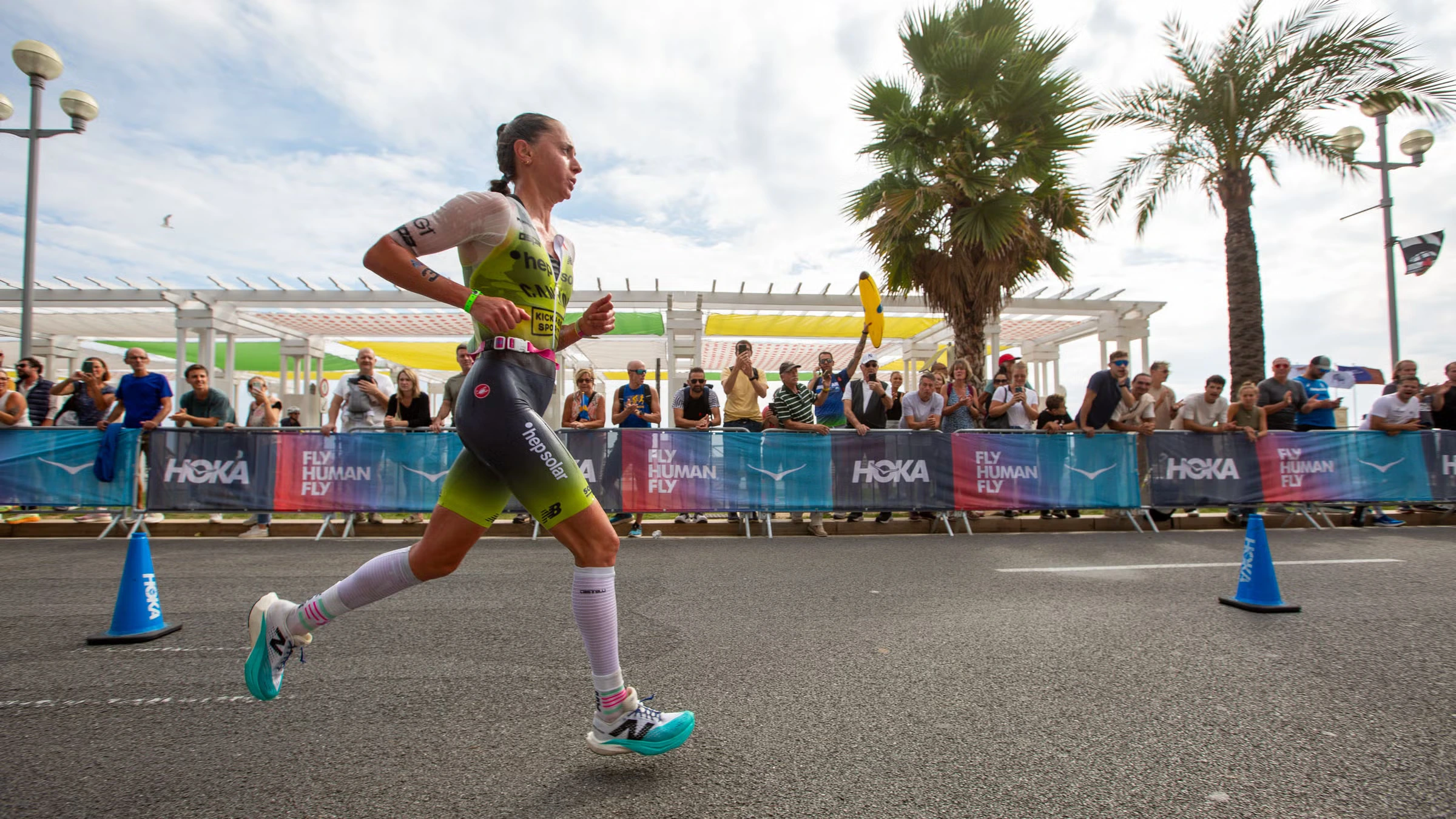
My wife said it while we were watching Lucy Charles-Barclay’s pre-Kona interview: with a name like that, she didn’t come from a council estate. It stuck with me, because it asks a much bigger question than one athlete’s family tree. Is triathlon an elite sport, the kind where you need money behind you from childhood? So I went through the Kona 2026 pro start lists, ten women and ten men, to see where these athletes really came from.
Short answer: triathlon is expensive to take part in, and long-course pros get very little public funding in many countries. Even so, the documented backgrounds on the Kona 2026 start list do not read like a roll call of rich kids. Most of these athletes found the sport through a swim club, a parent already in it, an army career or a university place.
How I picked the 20 athletes (and what I could not find out)
I used the Tri247 start lists for the women and the men, last updated on 7 and 10 October 2026. For each field, I took the first ten active athletes in bib order, replacing anyone who had withdrawn, such as Chelsea Sodaro (illness) and Stornes (crash).
Then I looked for four things for each athlete: when they started, where they grew up, what their parents did and whether the family helped pay. The first two are well documented. The last two are not. Pro triathletes talk about their parents as supporters, but almost never publish a mum’s job or a family’s income. I will tell you exactly where the evidence stops, and I will not guess past it.
The women: ten routes to the Kona start line
- Solveig Løvseth (Norway). She swam as a child in Trondheim, and at 14, her coach suggested triathlon because she was not improving in the pool. Norway’s national triathlon team was new and small, especially for women, so she made it quickly. Her coach from day one was Arild Tveiten. Parents: nothing published.
- Kat Matthews (Great Britain). She played hockey, basketball, tennis and cross-country, and swam for a local club just for fun. She only took up triathlon in 2015 while working as a physiotherapy officer in the British Army, and turned pro in 2019. She credits her husband Mark for his support.
- Laura Philipp (Germany). Born in 1987, she did not learn to swim until she was 24. The only parental detail I found is her mum’s cake-baking, which she credits for her daily slice of cake. Her husband Philipp Seipp coaches her.
- Hannah Berry (New Zealand). She grew up in Te Puke playing netball, volleyball and hockey, and came to triathlon late. She is now Dr Hannah Berry, and has been a member of the Adams Academy since it began, a development programme with around 100 athletes across 27 sports.
- Lisa Perterer (Austria). She entered her first triathlon at 15 on a rented bike that was far too big, after watching IRONMAN Austria. She represents an army sports club, joined the Austrian army’s high-performance scheme in 2011, and went on to three Olympic Games.
- Lucy Charles-Barclay (Great Britain). Born in Hoddesdon in 1993, she joined Hoddesdon Swimming Club at eight and collected county, regional and national medals. She missed selection for London 2012, quit swimming, worked in the marketing department of a wildlife park, and later signed up to IRONMAN UK with her now-husband, Reece. She kept a job as a personal trainer until she went full-time. Her mum, Elaine, appears in the PTO documentary coverage on Tri247, but her parents’ jobs are not published.
- Taylor Knibb (USA). Raised in Washington, D.C., she started triathlon at 11, inspired by her mother, Leslie, a racer and coach. She attended Sidwell Friends School and then Cornell, where her mother, maternal grandparents, and several uncles also studied. This is the most documented family background on either list.
- Sara Svensk (Sweden). She only began running in medical school and did her first triathlon in 2014, at age 25. She became Swedish champion the next year and has worked part-time as a doctor alongside racing.
- Leonie Konczalla (Germany). I could confirm she was racing European triathlon events by 2016, but I couldn’t confirm anything about her childhood or family.
- Lotte Wilms (Netherlands). She was an elite swimmer for 15 years, retired in 2012, and switched to triathlon in 2017. She is now based in Sydney. Her family background is not published.
The men: swimmers, cyclists and a few family businesses
- Gustav Iden (Norway). Born in Bergen into what he calls an active family. His father was the head coach of the local youth cycling team, and he started cycling because his older brother and sister did. At 14, he could not choose between cycling and running, so he chose both. He describes Triathlon Norway as having basically nothing when he joined.
- Kristian Blummenfelt (Norway). Also from Bergen, a competitive swimmer who won his first triathlon at 14 and joined the regional triathlon academy in 2011. His parents’ occupations are not public.
- Marten Van Riel (Belgium). He grew up in the farming town of Wuustwezel. His father had competed in triathlon but was a poor swimmer, so he put all three children into swimming lessons. Van Riel started competing in triathlon in 2009 and went on to the Rio and Tokyo Olympics.
- Sam Laidlow (France). Born in Bedfordshire, he moved to the Pyrenees as a toddler when his parents set up a triathlon training business. He did his first triathlon at four, and his father, Richard, coaches him. His mum, Michelle, and brother, Jake, are part of what Tri247 calls the ultimate family project. This is the closest thing on either list to a family that invested in the sport as a livelihood.
- Patrick Lange (Germany). He raced mountain bikes first and moved to triathlon at 15 after injuries. He turned full-time professional in 2012. I couldn’t find any information about his parents.
- Jonas Schomburg (Germany). Born in Hanover in 1994, he took up the sport at 10 in Bokeloh, encouraged by his father, Arnd, who competed internationally in the 1990s. He raced at the Tokyo 2020 Olympics.
- Nick Thompson (Australia). I found no reliable background beyond his racing record.
- Matthew Marquardt (USA). A swimmer who treated swimming as his ticket to college, he began focusing on triathlon in 2021 after his senior season as a Princeton swimmer was cancelled. He is now a medical student and says he relies on the support of his parents, girlfriend and sponsors.
- Jamie Riddle (South Africa). Born in Gqeberha around 2000, he grew up in long-distance triathlon through his father, Alec, an age-group 70.3 world champion in 2011 who has raced more than 50 70.3 events. Riddle has since raced at the Olympic Games.
- Cameron Main (Great Britain). From Elgin in Scotland, he started triathlon at 12 and was coached by his father until he joined the Scottish Triathlon Foundation Squad in 2013. He later trained at Loughborough with support from sportscotland. Earlier in his career, he said that without a top ranking, it is a struggle to afford the kit and travel for races.
What the 20 athletes have in common
Of the 20, I found usable backgrounds for 18. Three patterns stand out, and some athletes fit more than one.
- A parent or sibling was already in the sport (seven of 20): Knibb, Iden, Van Riel, Laidlow, Schomburg, Riddle and Main. Family involvement is the single most common thread. It is an advantage, but it is not the same as money.
- They started as adults or came from another career (six of 20): Matthews, Philipp, Svensk, Wilms, Berry and Marquardt. An army physio, a doctor, a medical student and a late-learning swimmer are not the usual picture of a childhood sports academy.
- They came through a swim club or a national federation as teenagers: Løvseth, Blummenfelt, Iden, Perterer, Lange, Schomburg, Main and Charles-Barclay. For these athletes, a coach or a federation spotted them early.
So my wife’s comment deserves a fair hearing. Across the 18 athletes I could research, the documented routes are mostly access routes (a parent, a club, an army post, a federation), not money routes. One small note on the name that started all this. Charles-Barclay is a married name. She was simply Lucy Charles when she took up triathlon, and her husband Reece Barclay is her coach. A surname tells you very little here.
Did parents pay? What the evidence shows
This is the section where I have to be careful. I found no source that states how much any of these 20 athletes’ parents spent on their sport, or what any parent earned. Nobody on either list has published a family budget. Anyone claiming to know which pros had rich parents is guessing.
What the sources do show is where help came from, and it is more varied than pocket money:
- Parents as coaches. Laidlow, Main (until 2013), Schomburg and Riddle all had a father involved in the training or the sport. Free coaching from a parent is real money saved, even if no cheque changed hands.
- Parents who made it a career. The Laidlow family relocated to the Pyrenees and built a triathlon training business. That is a family bet, not a trust fund.
- Parents who paid for education and travel. Knibb attended a private school and an Ivy League university. Marquardt says his parents still support him. I cannot say how much, or whether either had scholarship help.
- Institutions instead of parents. Matthews had a British Army salary; Perterer had the Austrian Army scheme; Berry had a regional academy; and Løvseth, Blummenfelt and Iden had a national federation.
The honest summary is that family support clearly mattered, but the documented routes rely more on access (a parent who coached, a swim club, an army post, a federation) than on a parent writing large cheques. I cannot rule out the cheques. I can only say no one has shown them.
Which countries do most for young athletes?
Here is the nationality count across the 100 starters in the professional fields (48 women and 52 men): Germany 14, the USA 13, Great Britain 10, Australia 10, France 9, Norway 5, Spain 5, and the Netherlands, Canada and Denmark with 4 each. Per head of population, Norway, Denmark and Australia punch far above their weight. That suggests a system, not just a pool of wealthy families.
Norway: a small country with a federation that looks for talent
Norway has about 5.5 million people and five of the 100 starters. Løvseth, Iden and Blummenfelt all came through national team or regional academy structures that spotted them as teenagers. According to Arild Tveiten, the Norwegian federation’s sports director, government money covers about half of a high-performance programme through the Olympic Committee, and sponsors must fund the rest. So even Norway is not fully state-funded.
Great Britain: strong pathway, no long-course support
Britain has eight of the 48 women and ten starters overall, but British Triathlon has said the National Lottery money it receives is ringfenced for Olympic and Paralympic disciplines and grassroots participation. It does not have the money to support long-course athletes. Sport England has put £120 million into inclusive talent pathways, partly because it recognises unequal access. The same announcement notes that developing a young athlete typically costs more than £6,600 a year. The Triathlon Trust has launched a small Pathway to Podium pilot to remove financial barriers for talented young athletes.
Germany and Austria: the army route
The Bundeswehr supports German elite sport, funding more than 800 athletes in around 70 sports, with the Deutsche Sporthilfe foundation backing athletes outside the forces. Austria runs a similar army scheme, and Perterer’s profile lists the Austrian army and Sporthilfe among her backers. For a kid without family money, this is a real route, although I could not confirm how many of Germany’s 14 starters used it. The Bundestag record says the foundation supports top athletes who are not employed by the forces, police or customs.
USA, New Zealand and France: universities, academies and family businesses
The American route runs through universities. Knibb swam and ran at Cornell, and Marquardt swam at Princeton. That is a good path if you can get in, and a closed door if you cannot. New Zealand has regional academies such as the Adams Academy. I found no national system behind Laidlow, whose route was his own family business.
What does triathlon cost, and who can afford it?
The sport itself is expensive: bikes, wetsuits, entry fees, travel and coaching. The survey data on amateurs is dated, but it points one way. A 2015 survey for the World Triathlon Corporation, put the average household income of IRONMAN participants at around $247,000. USA Triathlon put the average for all triathletes at $126,000. The 2016 USA Triathlon membership survey found over half of members had a household income above US$100,000 and more than 80 per cent held a degree.
So the typical amateur is affluent. The pros are a different group. Many documented here are medical professionals, soldiers, student-athletes, or coaches’ children, and several held down day jobs before turning professional. In Britain, for instance, long-course pros sit outside Lottery funding, so sponsors and prize money have to cover the bills.
I started in my late 30s, and I have since done 100+ races and six IRONMAN finishes. I’ve been too scared to calculate what a typical race season costs me.
So, is triathlon an elite sport?
Here is how I see it, based only on what the 20 profiles show.
As a hobby, triathlon is extremely expensive. The average participant earns well and holds a degree. Kit, travel, and entry fees keep out anyone on a tight budget, and I wouldn’t pretend otherwise.
As a route to the Kona start line, it is not a closed shop. Of 18 athletes I could research, seven had a family link to endurance sport, six started as adults, and eight came through a swim club or federation. No one was documented as coming from a wealthy family, although nobody has published their family finances either. Most had early access, whether through a father with a bike, a club pool, or a national team that was short of athletes and needed bodies.
The honest caveat is that access still depends on geography and parents. A kid in Hertfordshire with a swimming club and a lift to training starts ahead of a kid without either. Money helps with that gap. It doesn’t guarantee a podium, and the evidence shows you can reach the top as a late starter, a squaddie, or a med student.
Final thoughts: it’s about the doors that open
Back to my wife’s comment. The data cannot tell me what Lucy Charles-Barclay’s parents did for a living, and it would be unfair to guess. What it does show is a swimmer who missed an Olympic place, took a marketing job and a personal training job, and kept going. That is a story about persistence and timing, and nothing in it needs a postcode to explain. It is also a story about doors opening at the right time.
If you are curious where you might fit in, try my triathlon matcher quiz or browse the race directory for a first start line. My best triathlon races in Europe for 2027 guide covers the rest, and the Challenge Roth race report shows what a long-course day looks like for an age-grouper. Whoever you are, there is a start line for you. Which route into the sport sounds most like yours? Tell me in the comments.
Leave a Comment
You must be logged in to post a comment.