

The Mental Game: Why Most Triathletes Fail Before Start
The morning of a full-distance race has a particular atmosphere at the water’s edge. Wetsuits half-zipped, goggles pushed up, everyone quietly doing their own version of holding it together. At one such start, a guy next to me — clearly fit, clearly prepared — turned and said he wasn’t sure he was ready. Not because of his training. His training had gone well. But he’d had a bad session two weeks out, and he hadn’t been able to let it go.
We were about to swim 3.8km. His legs were fine. His aerobic engine was there. His mind, though, had already started writing a different story.
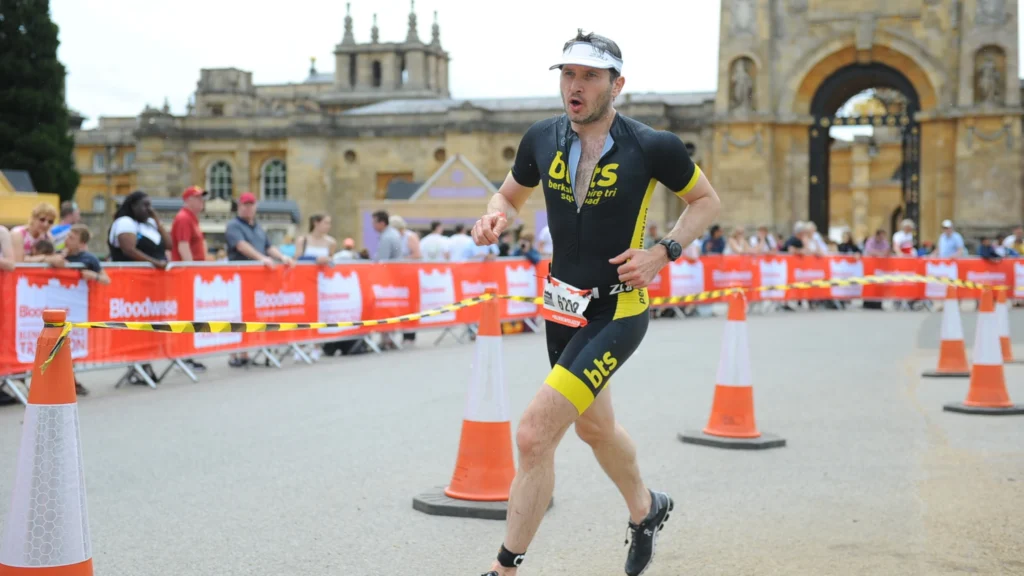
That conversation stuck with me, because I’ve had a version of it dozens of times — at club sessions with Berkshire Tri Squad, on start lines, in post-race debrief chats over coffee. The pattern is almost always the same: most triathlon failures don’t happen on race day. They happen in the weeks before, in the quiet moments of doubt, the negative self-talk during training, and the catastrophic thinking that turns one bad session into a mental referendum on your entire preparation.
The Inner Saboteur: How We Defeat Ourselves
Triathlon mental training isn’t just about positive thinking or visualisation techniques. It’s about recognising the specific ways our minds work against us in this beautifully complex sport.
The perfectionist trap catches many of us. Miss one swim session due to illness? Suddenly the entire race preparation feels compromised. Have a poor bike session where the legs feel flat? The mind immediately jumps to race day disaster scenarios.
I see this pattern repeatedly in club training. Athletes with months of solid preparation convince themselves they’re underprepared because of one bad week. The irony? Their fitness is usually exactly where it needs to be.
Then there’s comparison syndrome. Social media makes this worse, but it existed long before Instagram. Seeing someone else’s interval splits or race photos triggers the “I’m not good enough” narrative. We forget that everyone’s journey looks different, and those highlight reels never show the struggles.
Sports Psychology for Triathletes: The Confidence Equation
Confidence in triathlon isn’t about feeling bulletproof. It’s about trusting your preparation and accepting uncertainty. Research shows that self-efficacy is one of the strongest predictors of athletic performance, yet most of us spend more time planning our nutrition than developing mental resilience.
Real confidence comes from evidence, not emotion. Keep a training log that captures not just times and distances, but how sessions felt, what worked well, and small improvements. When race nerves hit, you have concrete proof of your preparation.
During my build-up to Challenge Roth, doubt crept in regularly. The German heat, the hills, the competitive field. Instead of fighting these thoughts, I acknowledged them and refocused on what I could control: my pacing strategy, nutrition plan, and race day routine.
The breakthrough came when I shifted from “I hope I can finish” to “I’ve done the work, now let’s see what happens.” Same preparation, completely different mental approach.
The Pre-Race Psychology Minefield
Race week amplifies every mental tendency. Suddenly every twinge feels like an injury, every yawn signals overtraining, and every weather forecast becomes a personal challenge.
The taper madness is real. Reduced training volume leaves mental space for worry. Your coach (in my case, the brilliant Nathalie Lawrence) designs the taper for physical freshness, but the mind often interprets it as lost fitness.
Understanding this helps enormously. Those heavy legs during taper week? Normal. The sense that you’re losing fitness? Psychological. The sudden urge to squeeze in extra sessions? Ignore it.
Create non-negotiable race week routines. Not superstitions, but practical anchors that keep your mind occupied with useful tasks rather than worry spirals. Having a solid race checklist helps here too.
Reframing the Narrative: From Fear to Curiosity
The most powerful mental shift I’ve made is changing my relationship with race day uncertainty. Instead of fearing what might go wrong, I became curious about how I’d respond to challenges.
Mechanical issues, weather changes, nutrition problems become interesting puzzles rather than race-ending disasters. This isn’t toxic positivity; it’s practical resilience. Problems will occur. Your response determines the outcome.
During training, practise this mindset shift. When a session goes sideways, ask “what can I learn?” instead of “why is this happening to me?” The mind learns from these small moments of reframing.
Visualisation works, but not the Hollywood version. Don’t just imagine perfect performances. Mentally rehearse responding well to common challenges. What happens if your goggles get kicked off in the swim? How do you handle a puncture? This mental preparation builds genuine confidence.
The Social Dimension: Managing Others’ Expectations
Triathlon attracts goal-oriented people, which creates an interesting social dynamic. Everyone wants to know your target time, your expectations, your predictions.
Learn to deflect these conversations gracefully. “I’m excited to see what happens” works better than specific time goals that become mental pressure. Share your enthusiasm for the experience rather than performance predictions.
Race day conversations matter too. The start line is full of nervous energy and wild predictions. Some athletes thrive on this chatter; others find it destabilising. Know which category you fall into and position yourself accordingly.
Building Mental Resilience: The Long Game
Mental training isn’t a race week add-on. Like physical fitness, it develops through consistent practice over months and years.
Start small. Notice negative self-talk during training sessions. When the voice says “this feels terrible, you’re not ready,” counter with facts: “this is interval five of eight, fatigue is expected and normal.”
Embrace process goals over outcome goals. Instead of “I must go sub-5 hours,” focus on “I’ll execute my pacing plan and stay present.” Process goals remain within your control regardless of conditions or competition.
Develop perspective. Yes, triathlon distances are challenging, but they’re also temporary. The longest Ironman swim is 3.8km. It ends. The bike leg, however hilly, has a finish line. The marathon has a literal endpoint.
This isn’t about minimising the challenge, but contextualising it. Hard doesn’t mean impossible, and temporary discomfort isn’t permanent damage.
Race Day Execution: Mind Over Miles
Race morning mental preparation matters as much as your high-protein breakfast. Have a mental routine alongside your physical preparation.
I use a simple three-part approach: acknowledge nerves as normal and useful, review my process goals for each discipline, and remind myself why I chose to be here. Not dramatic self-talk, just practical mental preparation.
During the race, stay present. The mind wants to jump ahead (“only 20km of cycling done, 160km to go!”) or behind (“that transition was slow, race ruined”). Both directions lead away from optimal performance.
Use mile markers, aid stations, or gear changes as mental reset points. Each section becomes a mini-race with its own focus and intention.
The Aftermath: Learning and Growth
Post-race analysis should include mental performance alongside physical metrics. What thought patterns helped? Which ones hindered? How did you respond to challenges?
Every race, regardless of outcome, provides mental training data. Use it wisely, and the next start line becomes an opportunity rather than a test.
The beautiful truth about triathlon mental training is that it improves everything else too. The resilience, focus, and perspective developed through sport psychology translate directly to work challenges, family pressures, and life’s inevitable curveballs.
So before your next race, invest as much energy in mental preparation as physical training. Your mind is either your greatest asset or biggest limitation. The choice, refreshingly, remains entirely yours.

Leave a Comment
You must be logged in to post a comment.