
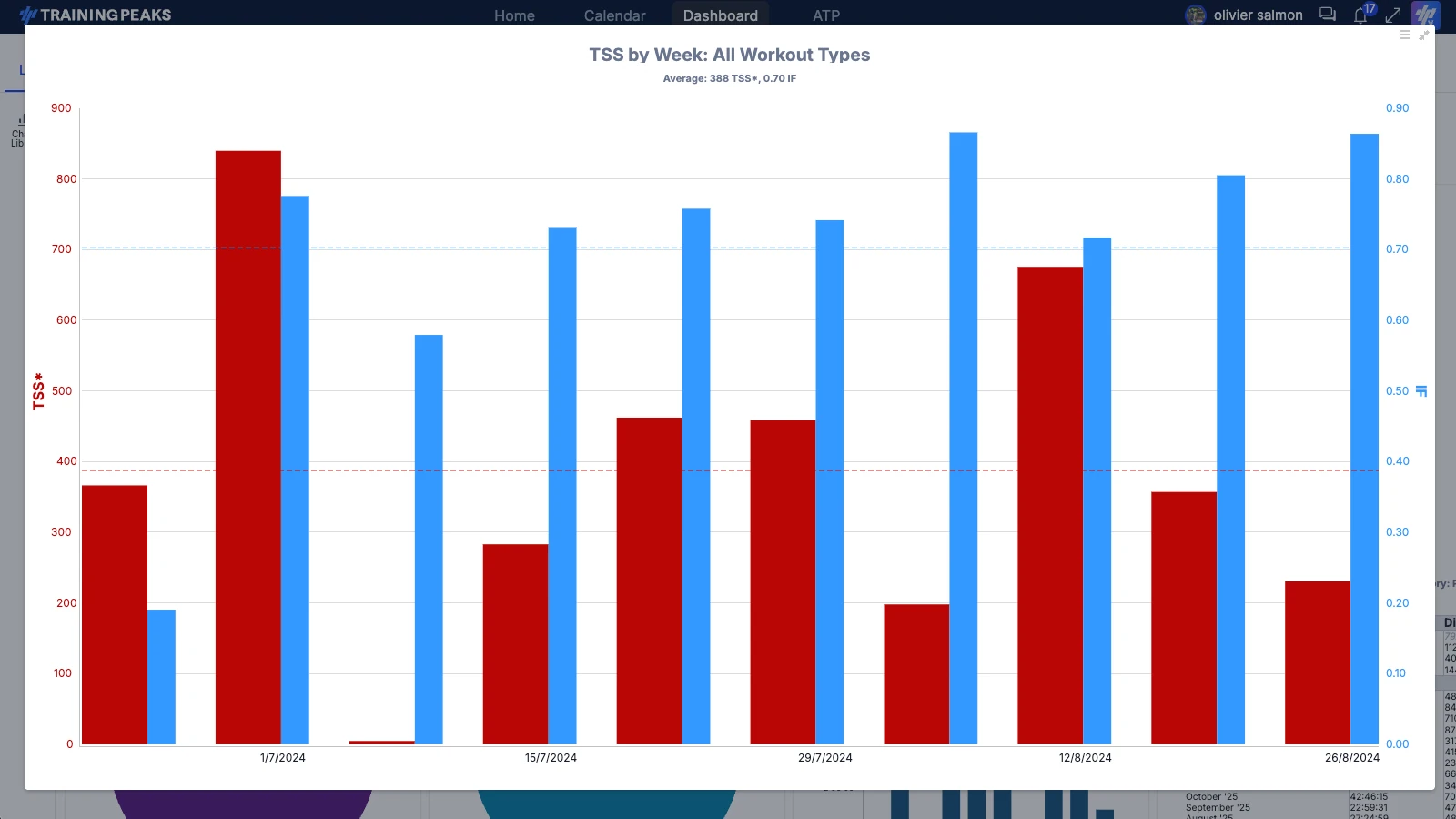
Having a coach takes a lot of the guesswork out of training. Nathalie handles the planning, monitors my TrainingPeaks data, and adjusts the load before I even realise something’s off. But understanding the numbers yourself still matters. Knowing what Training Stress Score actually means helps you make sense of why some weeks feel brilliant, and others feel like you’re training through treacle.
Training Stress Score (TSS) is a metric that quantifies your training workload by combining intensity and duration into a single number. For triathletes, it’s one of the most useful tools for planning weekly load, avoiding overreaching, and making sure recovery actually happens rather than just being scheduled.
Understanding Training Stress Score Fundamentals
TSS measures the physiological stress of a training session on a 100-point scale, where 100 TSS equals one hour at threshold intensity. A gentle recovery ride might score 20-30 TSS, whilst a hard interval session could rack up 80-100 TSS in the same timeframe.
The beauty of TSS lies in its simplicity. Unlike heart rate zones that fluctuate with fatigue, caffeine, or temperature, TSS gives you a consistent way to measure load across all three disciplines. It was one of the first things that clicked when I started using TrainingPeaks with my first coach, and it changed how I thought about structuring a training week.
TSS calculation requires knowing your Functional Threshold Power (FTP) for cycling, threshold pace for running, and Critical Swim Speed (CSS) for swimming. These benchmarks establish your personal “100%” effort level, making TSS relative to your current fitness.
Weekly TSS Targets for Different Training Phases
Your optimal weekly TSS depends on your experience level, current fitness, and training phase. Beginners typically manage 300-500 TSS weekly, whilst experienced athletes might handle 800-1200 TSS during peak training blocks.
During base-building phases, my weekly TSS sits around 400-500, with steady aerobic sessions across all three disciplines. Build phases push that closer to 550-700 as interval work increases. Peak weeks ahead of an Ironman might touch 750-800, but only briefly before the taper kicks in. Recovery weeks drop back to 300-400, roughly 60% of normal load.
The key insight from TrainingPeaks research shows that consistency matters more than absolute numbers. Better to maintain 600 TSS weekly for months than spike to 900 TSS, then crash to 200 TSS the following week.
Distributing TSS Across Swim, Bike, and Run
Triathlon TSS distribution typically follows the 70.3 or Ironman race split: roughly 10-15% swimming, 50-55% cycling, and 35-40% running. However, this varies depending on your limiters and race-distance focus.
For sprint-distance racing, I increase running TSS to 40-45% whilst reducing cycling TSS to 45-50%. The higher running intensity in shorter races demands more sport-specific stress. Conversely, full Ironman preparation sees cycling TSS rise to 55-60% as bike volume becomes crucial.
Swimming TSS often gets neglected because the absolute numbers seem small. A hard 3000m pool session might only generate 50-60 TSS, but it still imposes significant neuromuscular stress. Don’t dismiss swimming TSS simply because it’s lower than your weekend bike ride.
Planning Your Weekly TSS Structure
Successful weekly TSS planning starts with your key sessions. Identify your hardest workout in each discipline, calculate their TSS, then build supporting sessions around them. My typical build phase week looks like this:
- Tuesday: Bike intervals (90-100 TSS)
- Wednesday: Run tempo (60-70 TSS)
- Thursday: Swim intervals (45-55 TSS)
- Saturday: Long bike (120-150 TSS)
- Sunday: Long run (80-100 TSS)
Supporting sessions fill the gaps with easy aerobic work: recovery swims (20-30 TSS), easy runs (40-50 TSS), and spin sessions (30-40 TSS). This approach ensures I hit my weekly target whilst maintaining proper hard/easy balance.
Avoid front-loading your week with high TSS sessions. Spreading intensity across Monday-Friday allows for better recovery and higher-quality efforts than cramming everything into two days.
Using TSS to Prevent Overtraining
TSS becomes invaluable for monitoring accumulated fatigue. Training Stress Balance (TSB) shows whether you’re absorbing training stress or accumulating excessive fatigue. Positive TSB indicates freshness, whilst negative TSB shows training load accumulation.
During heavy training blocks, I’ll run TSB between -20 and -40, indicating significant fatigue but manageable stress. If TSB drops below -50, performance suffers and the risk of illness increases. That’s when I reduce my weekly TSS by 20-30% to recover.
It’s a pattern that repeats across most serious training blocks. Push too hard for too long without a recovery week, and the numbers will tell you before your legs do. That’s precisely why Nathalie keeps a close eye on my TrainingPeaks data, and why even a basic understanding of TSB is worth having as an athlete.
Common TSS Planning Mistakes
Many triathletes make the mistake of chasing arbitrary TSS numbers rather than focusing on training quality. TSS should guide your training load, not dictate your sessions. If you’re feeling fantastic at 650 TSS weekly, don’t force 800 TSS because someone online said you should.
Another common error is ignoring the TSS distribution within each day. Scheduling a 100 TSS bike session immediately after an 80 TSS run creates excessive single-day stress. Better to spread these sessions across different days for improved adaptation.
Don’t forget that life stress affects TSS absorption. Work deadlines, family commitments, and poor sleep all impact your ability to handle training load. Reduce planned TSS by 10-20% during stressful life periods to maintain training consistency.
Technology and Tools for TSS Tracking
Modern training platforms make TSS tracking straightforward. TrainingPeaks remains the gold standard, automatically calculating TSS from power meters, GPS watches, and heart rate monitors. Most athletes find the basic subscription sufficient for TSS monitoring and weekly planning.
Garmin Connect and Strava offer TSS equivalents called “Training Load” and “Relative Effort” respectively. Whilst not identical to TSS, these metrics provide similar insights for training load management. The key is consistency – pick one platform and stick with it.
For swimming TSS, you’ll need to manually input sessions unless using specific swim power meters. Most athletes estimate swimming TSS based on perceived effort and duration, which provides adequate accuracy for training load monitoring.
Adapting TSS Plans Throughout Your Season
Your TSS capacity changes throughout the season as fitness improves. What felt like 700 TSS in January might feel like 600 TSS by June as your body adapts. Regular lactate threshold testing helps recalibrate your zones and maintain accurate TSS calculations.
Race schedule also influences TSS planning. Build your highest TSS blocks 6-8 weeks before key races, then gradually reduce load during taper periods. I typically drop TSS by 20% two weeks before racing, then 40% in race week, whilst maintaining some intensity.
Post-race recovery requires TSS attention, too. After Challenge Roth, my weekly TSS dropped right back as easy movement replaced structured training. By mid-August, around four weeks post-race, my TSB had returned to +16, a clear sign the body had absorbed the effort and was ready to build again. That patient approach is what prevents post-race burnout and sets up the next training block properly.


Leave a Comment
You must be logged in to post a comment.