
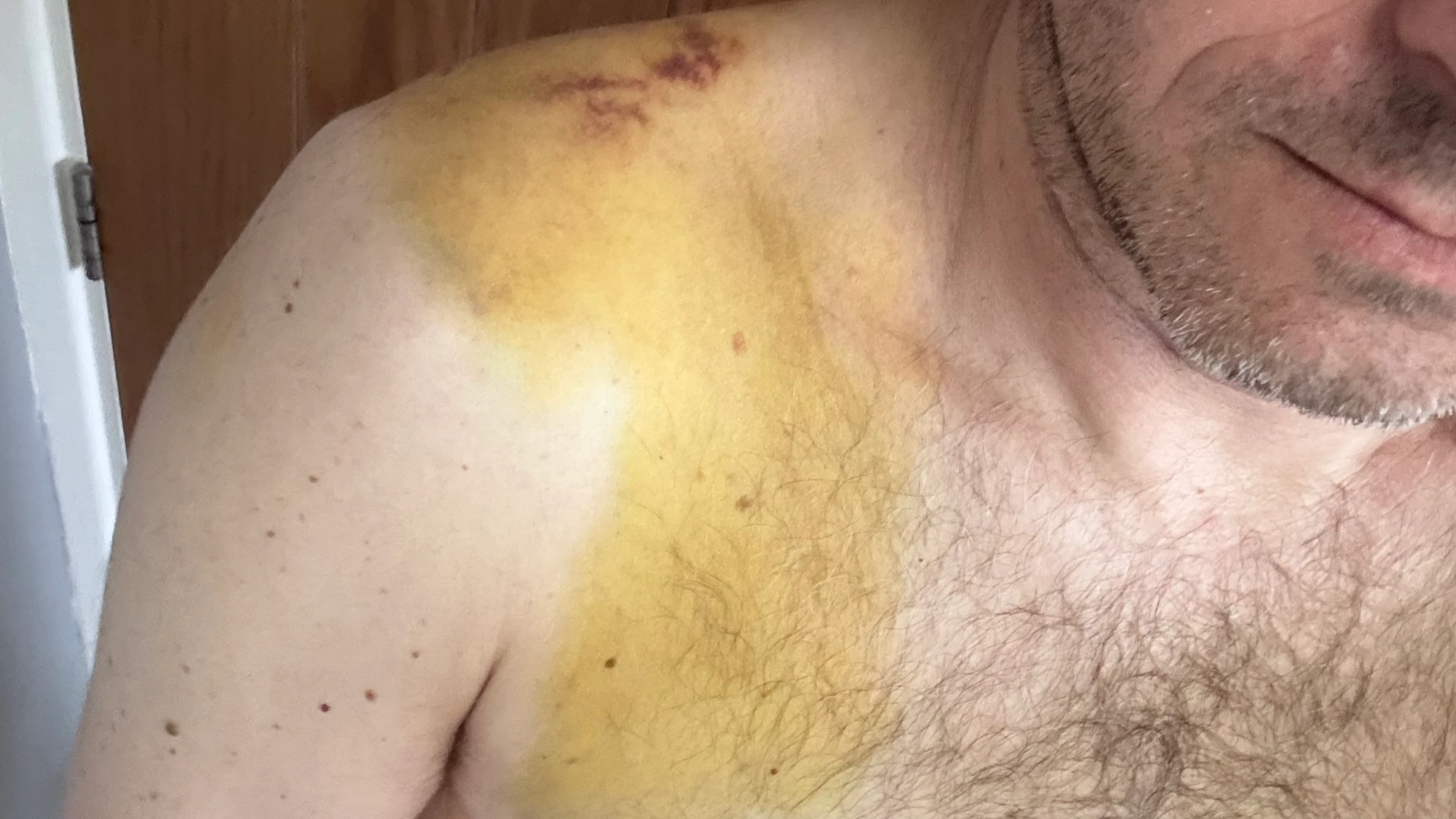
Getting hit by a car and breaking your collarbone is one way to test your mental resilience. No dramatic hospital bed — just an X-ray, a sling, a cast, and the sudden realisation that my 2025 season (70.3 Tours and full IM Les Sables, since you’re asking) was going to look very different from what I’d planned. That moment taught me more about the mental side of triathlon than any race ever could.
Injury is perhaps the most challenging aspect of triathlon that we rarely discuss until it happens to us. Research suggests more than half of iron-distance triathletes will deal with an overuse problem during any given training season — and that’s before you factor in the ones who don’t see the car coming. The physical healing is often the easy part. It’s the mental battle that truly tests our resilience.
The Emotional Rollercoaster of Injury
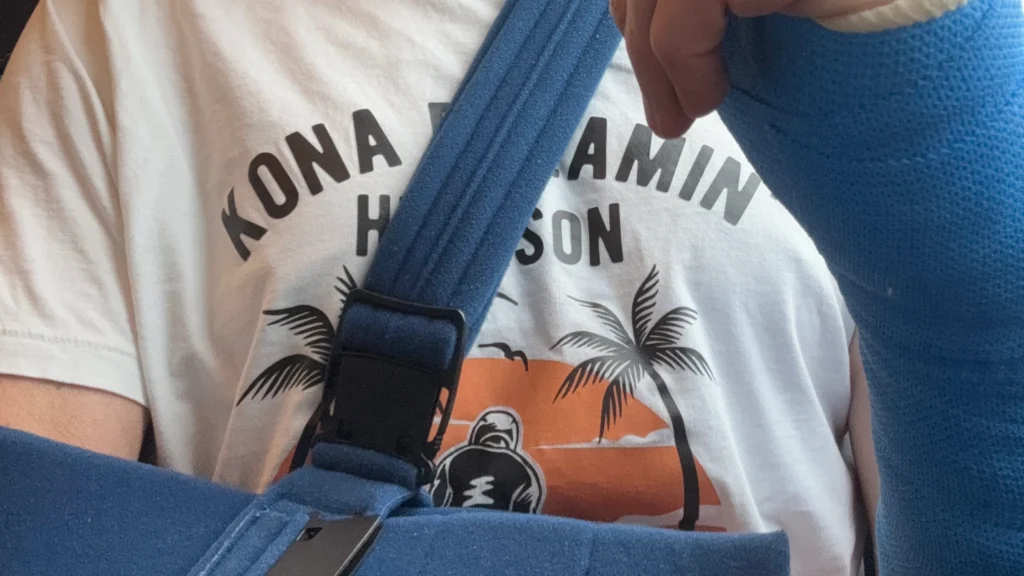
One arm in a sling, the other in a cast — and somehow I still managed to doom-scroll through everyone else’s Strava uploads. Turns out opposable thumbs are overrated until you don’t have them.
When injury strikes, we experience genuine grief. There’s denial (“It’s just a niggle”), anger (“Why me? Why now?”), bargaining (“Just let me finish this one race”), depression, and eventually acceptance — roughly in that order, though in my experience denial lasts considerably longer than the textbooks suggest.
Understanding this process is crucial for triathlon injury recovery.
The first few days are usually the hardest. You watch training partners head out for sessions whilst you’re stuck on the sofa. Social media becomes a minefield of race photos, and Strava uploads that you absolutely shouldn’t look at and definitely will. The fear creeps in: Will I lose fitness? Can I make my goal race? Will I ever be the same athlete again?
These feelings are completely normal. Acknowledging them rather than fighting them is the first step towards healing — both physically and mentally.
Reframing Your Perspective
Here’s what I discovered during my recovery: injury isn’t a full stop; it’s a comma. This mindset shift transforms everything about how we approach setbacks.
Instead of viewing injury as lost time, consider it an opportunity. When did you last have time to focus on mobility work? Or catch up on that yoga routine you’ve been meaning to start? Suddenly, you have space to address the fundamental aspects of athleticism that busy training schedules often squeeze out.
Research in sports psychology and mental health suggests that athletes who approach injury with optimism and a focus on growth tend to cope better and report greater personal development through the process. They view challenges as opportunities to develop rather than threats to their identity.
Practical Strategies for Mental Resilience
Focus on What You Can Control
Make a list of everything within your control during recovery. This might include nutrition, sleep quality, rehabilitation exercises, or mental training. When anxiety about the uncontrollable future creeps in, redirect your energy towards these actionable areas.
Plant-based nutrition becomes even more important during recovery. Foods rich in anti-inflammatory compounds — tart cherry, turmeric, walnuts, and flaxseeds — support healing whilst maintaining the nutritional habits that serve your long-term goals.
Set New, Relevant Goals
Your original race goals might be on hold, but that doesn’t mean you stop progressing. Set recovery-specific targets: complete all physio sessions, improve flexibility markers, or master that technique you’ve been neglecting. Easier said than done, of course — there will be days when the sofa wins, and the physio exercises don’t get done. That’s fine. The point is having something to aim at.
During my collarbone recovery, I wish I’d been more disciplined about this. I went into Ironman Cascais six months later with barely any training under my belt — surviving rather than racing. Looking back, the windows were there: the one-armed core work I kept meaning to do, the visualisation sessions I never quite started, the nutrition timing I could have dialled in properly. I did some of it. Not enough. If I had, I suspect Cascais would have felt a lot different.
Maintain Your Routine
Keep as much of your normal structure as possible. Wake up at the same time, follow your pre-training nutrition routine, then use that training time for rehabilitation or alternative activities. This preserves the psychological patterns that support your athletic identity.
The Power of Perspective
Research published in the British Journal of Sports Medicine found that psychosocial factors — particularly self-confidence and anxiety levels — significantly influence rehabilitation outcomes. Restoring confidence while reducing fear of reinjury is, it turns out, as important as the physical work itself.
Connect with your training community during recovery. Join your triathlon club’s coffee mornings even if you can’t train. Share your experience—you’ll be surprised how many others have been where you are. Sometimes, being the person who listens to someone else’s frustrations about their injury reminds you that you’re not alone on this journey.
Learning from Setbacks
Every injury carries lessons if we’re willing to learn. Perhaps you pushed through warning signs, neglected recovery, or had imbalances in your training. Use this time to honestly assess what led to the setback without dwelling on regret.
Working with my coach, Nathalie, during recovery was something I didn’t appreciate enough at the time. While I was busy feeling sorry for myself, she was quietly identifying what I could do rather than fixating on what I couldn’t — introducing activities outside my usual training patterns that kept me moving and kept me going more than I’d have managed on my own. That diligence, more than anything else, is probably what got me to the Cascais start line at all.
Consider this your opportunity to become a more well-rounded athlete. Study the sport differently—watch technique videos, read about periodisation, and understand the science behind what you do. This intellectual engagement maintains your connection to triathlon whilst your body heals.
Building Anti-Fragility
The goal isn’t just to return to where you were—it’s to come back better. Anti-fragility is the concept of becoming stronger through stress rather than simply recovering from it.
Use your recovery period to address weaknesses you’ve been ignoring. Poor hip mobility? Now you have time to fix it. Neglected strength work? Perfect timing. This comprehensive approach often results in athletes returning stronger than they were before injury.
Document your journey through recovery. Future you will thank present you for these insights when facing the next inevitable challenge. Plus, sharing your story might help another athlete who’s struggling with their own setback.
The Return
Coming back from injury requires patience and humility. Your first few sessions might feel frustratingly difficult, but remember that fitness returns faster than you lose it, especially with a solid base built over years of consistent training.
Celebrate small victories. That first pain-free swim, your initial post-injury bike ride, the moment you realise you’re not thinking about the injury anymore. These milestones matter more than any split time or power number.
Setbacks are temporary, but the mental strength you develop overcoming them lasts forever. Every challenge you face builds resilience that serves you not just in sport, but in every aspect of life.
So if you’re currently sidelined, remember: this isn’t the end of your story. It’s simply a plot twist that might just lead to your best chapter yet. Trust the process, focus on what you can control, and keep moving forward. Your comeback story is waiting to be written.

Leave a Comment
You must be logged in to post a comment.